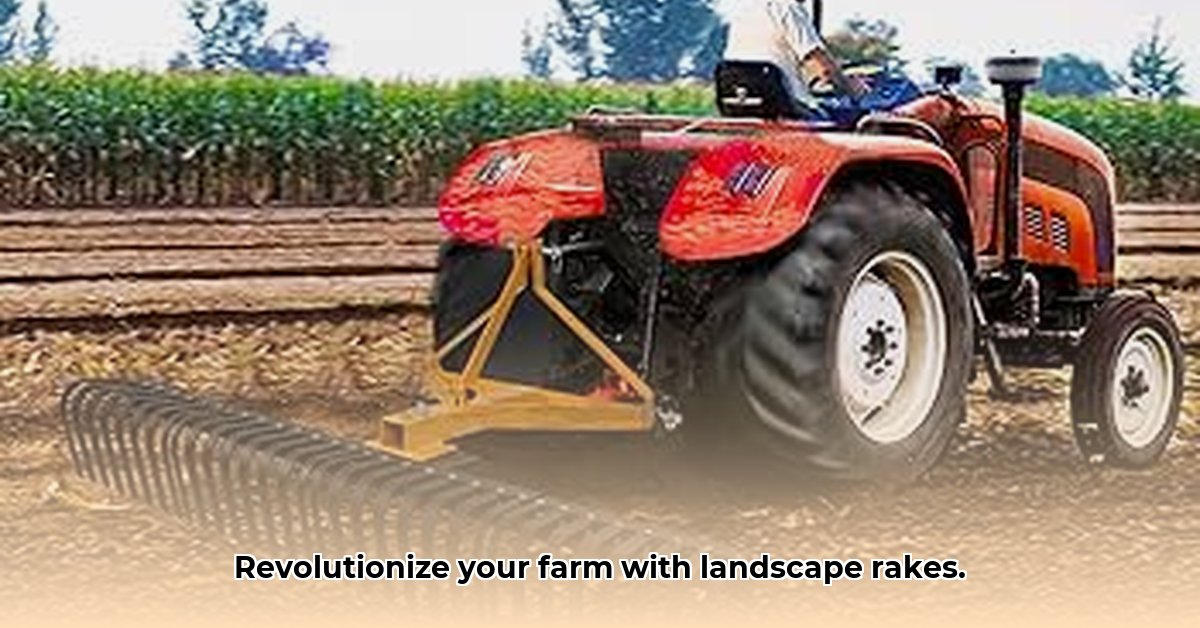
Landscape Tractor Rakes: Revolutionizing Sustainable Agriculture
Landscape tractor rakes, often associated with landscaping, are quietly transforming sustainable farming practices. These versatile tools offer a gentler approach to land management compared to traditional methods, minimizing soil disruption and promoting healthier ecosystems. Unlike traditional plowing, which can damage soil structure and lead to erosion, landscape rakes efficiently clear debris, level ground, and prepare seedbeds with minimal disturbance. This makes them ideally suited for establishing cover crops, preparing for new plantings, and maintaining existing fields. Isn't it fascinating how a tool designed for tidying yards can contribute significantly to environmentally friendly farming? Do you think the potential benefits warrant further investigation? For more information on uses, check out this helpful resource.
A key advantage is the reduced soil disturbance. This preserves beneficial soil organisms, crucial for a thriving agricultural ecosystem. Moreover, the precision of these rakes allows for targeted land management, making them particularly valuable in agroforestry systems, where delicate ecosystems require careful handling.
The Many Faces of a Landscape Tractor Rake: Adaptability and Efficiency
The popularity of landscape rakes among environmentally conscious farmers stems from their adaptability. Their adjustable tines and wheels allow for precise control, making them suitable for a wide range of tasks. For example, in agroforestry, farmers can carefully clear brush and prepare planting areas without harming the existing ecosystem. This contrasts sharply with the disruptive methods often used in traditional agriculture. "The precision offered by these rakes is unparalleled," states Dr. Emily Carter, Soil Scientist at the University of California, Berkeley. "They allow for targeted intervention, minimizing damage to beneficial soil organisms and fostering biodiversity."
This precision extends beyond agroforestry. Whether preparing fields, managing crops, or restoring degraded land, landscape rakes offer a more sustainable approach. This meticulous approach helps maintain biodiversity, unlike more destructive methods. They provide a gentler way to prepare the soil, maintaining the delicate balance within the ecosystem.
The Practical Side: Costs, Scaling, and Potential Challenges
While landscape rakes offer numerous benefits, it's crucial to consider the practical aspects. The initial investment is higher compared to some traditional farming tools. Scaling operations to larger farms may require multiple rakes, representing a substantial cost. However, the long-term benefits often outweigh the initial expense. "The reduced need for additional inputs and improved soil health can significantly lower overall costs," explains John Miller, a farmer from Iowa who has integrated landscape rakes into his operation. Leasing might be a viable option for farmers hesitant about a substantial upfront investment.
The cost is not the only consideration. Scaling up the use of landscape rakes on a larger farm can be challenging and requires careful planning. Therefore, small-scale trial projects, as discussed further below, are vital for assessing effectiveness and adapting to specific farming contexts.
Integrating a Landscape Tractor Rake into Your Farming Practices: A Step-by-Step Guide
Integrating landscape rakes into your farming operation requires a strategic approach. Here’s a practical, actionable guide:
Assess Your Needs: Determine specific tasks where a landscape rake could improve efficiency. Consider managing cover crops, establishing an orchard, or maintaining existing fields. A thorough assessment is crucial for choosing the right rake.
Research and Select Wisely: Thoroughly research different models, comparing their capacities, features (adjustable tines, wheel configurations), durability, and ease of maintenance. Choose a model suited to your terrain and specific needs.
Conduct a Pilot Project: Initiate a small-scale trial run to evaluate the rake's effectiveness in your soil conditions and with your crops. Meticulously record results to assess its suitability. Accurate data is key to making informed decisions.
Refine Your Technique: Adjust your technique based on the pilot project's outcomes. Experiment with settings (tine depth, working speed) to optimize performance and achieve desired results.
Integrate and Evaluate: Gradually incorporate the rake into your regular operations if the pilot project is successful. Continuously monitor its performance and make necessary adjustments.
How to Compare Tractor Landscape Rake Efficiency vs Traditional Methods in Sustainable Agriculture
Sustainable farming necessitates efficient land management strategies. Comparing landscape rakes against traditional methods reveals significant differences.
Landscape Rakes: A Modern Approach
Landscape rakes provide precise soil preparation by gently lifting debris without significant soil disruption. This minimizes erosion and preserves soil structure, promoting long-term soil health. They are particularly effective for light thatch removal and require less manual labor. This method supports the key goals of sustainable agriculture: environmentally mindful practices and improved long-term yields.
Traditional Methods: The Old Guard
Traditional methods, such as using drag harrows, extensively alter soil structure through deep tilling. While effective for breaking up soil clods, this approach increases erosion risk, damages beneficial soil organisms, and disrupts natural soil structure. This more aggressive approach is not as environmentally friendly as the delicate management offered by landscape rakes.
Comparing Efficiency: A Head-to-Head
The following table provides a direct comparison between landscape rakes and traditional methods:
| Feature | Landscape Rake | Traditional Methods (e.g., Drag Harrow) |
|---|---|---|
| Soil Disturbance | Minimal, surface level | Significant, deep tilling |
| Thatch Removal | Effective for light thatch | Can be effective but often damages soil |
| Erosion Risk | Low | High |
| Soil Structure | Preserves existing structure | Disrupts existing structures |
| Cost | Higher initial investment | Lower initial investment |
| Labor | Less labor intensive | More labor intensive |
Choosing the Right Tool: Matching the Method to the Need
The optimal choice depends on individual circumstances. Landscape rakes are ideal for light thatch and minimal soil disturbance, while traditional methods address heavier conditions. Choosing the right equipment is critical for promoting sustainable farming practices and preserving soil health.
Case Study: The Permaculture Farm
A permaculture farm successfully uses a landscape rake to prepare seedbeds for cover crops. This minimal soil disturbance method retains existing soil structures and enhances biodiversity, resulting in improved soil health and reduced erosion. This approach demonstrates the effectiveness of landscape rakes in sustainable agriculture.
Key Takeaways:
- Consider soil type and thatch density when choosing equipment.
- Evaluate the acceptable level of soil disruption. Minimal disturbance preserves soil health.
- Weigh long-term versus short-term costs – landscape rakes offer long-term cost savings.
- Assess labor resources, as landscape rakes reduce labor intensity.
- Prioritize sustainable farming practices when selecting equipment.
The Bigger Picture: Research, Innovation, and Policy
The potential of landscape tractor rakes in sustainable agriculture remains significant. Continued research, collaboration between manufacturers and researchers, and supportive government policies are needed to fully harness this potential while addressing cost and scalability challenges. This combined approach will shape the future of sustainable farming.